
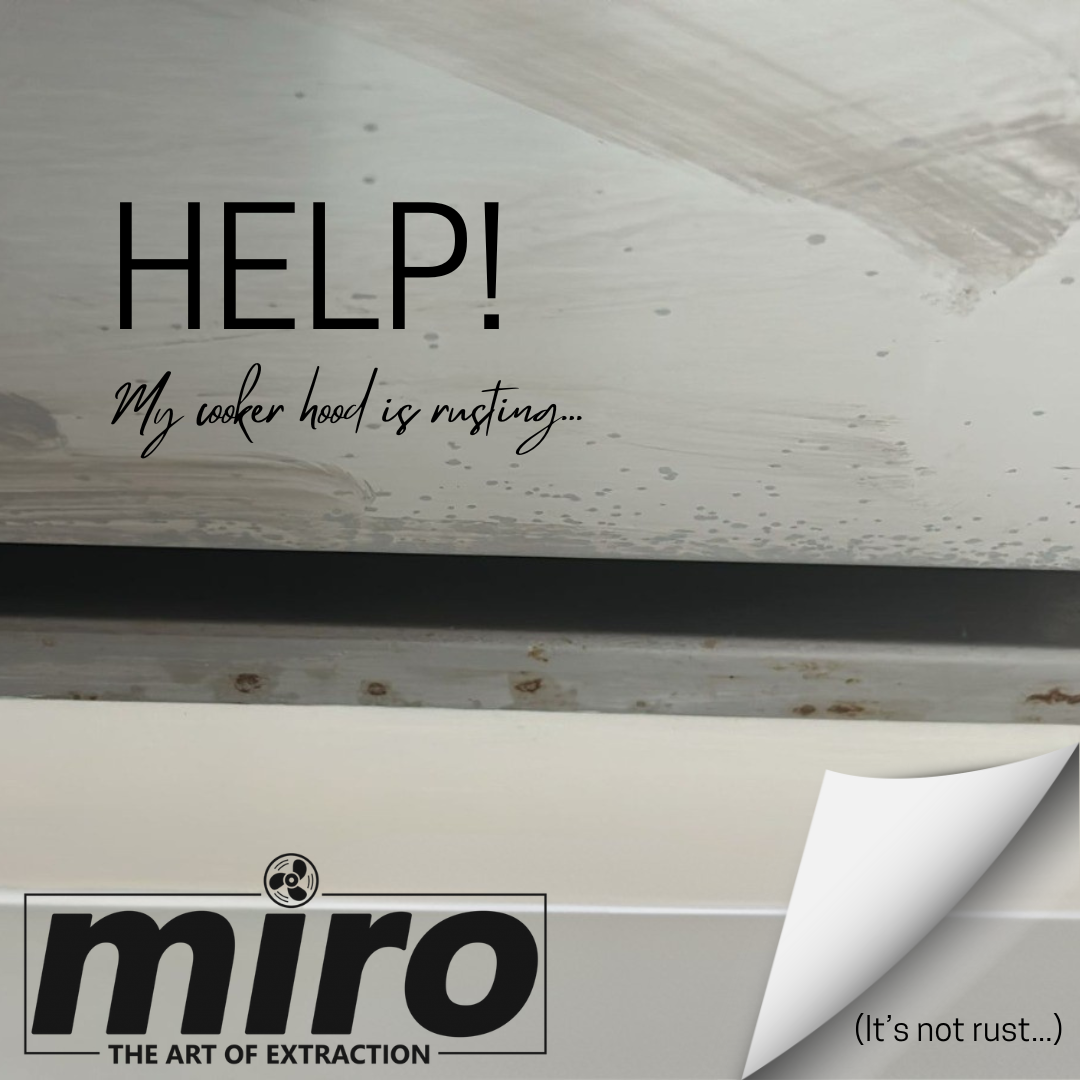
HELP!
We recently had an email sent to our Support team from an end-user, concerned that his stainless steel cooker hood was rusting.
It certainly looks like rust, we appreciate! However, this discolouration to the hood is something that has formed due to the thin chromium layer of the stainless steel being weakened.
Stainless steel doesn’t rust if it is maintained properly. If it rusts because of inadequate maintenance, then it has been left wet for too long, exposed to salt or has been scratched and damaged – which would invalidate any warranty on the product.
But in short, it’s not rust.
So if it’s not rust, what is it…?
In simple terms, it’s what is called an ‘environmental attack’. What causes such a reaction? It could be one of a range of factors including, but not exclusively, a lack of air circulation, condensation, humidity or damp conditions, chloride contamination or damage caused by oils and salts.
When stainless steel is exposed to these adverse conditions, several visible changes may occur including tea staining (brownish surface discolouration), surface rust markings (rust-like discolouration caused by breakdown of the protective layer), pitting corrosion (small pinholes in the surface) or general discolouration and dulling.
How do I help prevent this?
At the point of installation, ensure you leave all protective film/covers on until the very final stages – or better still, remove them just before the end-user begins using the product!
Remove any ‘construction debris’ from the product that may have come into contact with the hood, such as cement, plaster, brick dust etc) promptly!
Ventilation – ensure you have adequate airflow to the property, even when the property is unoccupied, to prevent stagnant humidity.
Do not allow products containing salts, strong detergents or bleach to remain in contact with the stainless steel.
Longer-term maintenance? WD-40 is a wonder when it comes to cutting through grease on stainless steel! A small amount sprayed on a microfibre cloth will help improve the aesthetics of your product, whilst ensuring you’re maintaining it properly.
Do NOT use any rough scrubbing pads on the stainless steel whilst cleaning your hood – you will risk scratching the hood and be unable to remove these later.
Conclusion…
Environmental attack is not a material fault but the result of adverse conditions within an unoccupied property. Stainless steel requires oxygen and a dry, clean environment to maintain its passive protection layer. Without these conditions, rust-like markings, staining, or even pitting can occur.
With proper care, cleaning, and preventative measures, the aesthetic finish and long-term durability of stainless steel can be preserved. Best solution for this is either WD-40 and a microfibre cloth, Bar Keepers Friend or a commercial calcium cleaning product. A good wipe down with one of these and a microfibre cloth, it should bring it up clean. We tend to use WD-40 when necessary, it’s a degreaser and works wonders on stainless steel.
How to maintain your hood…
We often point people in the direction of our maintenance page, simply as a way of educating the best way to get the optimum performance from your cooker hood.
You can find the article linked here on how best to take care of your product!
Link: MIRO SUPPORT | The importance of maintenance! – Miro Products | Premium Extractor Hoods