

Your kitchen extractor isn’t just removing smells.
When we think about kitchen extraction, most of us probably think about one thing:
Getting rid of cooking smells.
But there’s considerably more going on when you’re cooking.
Frying, grilling, roasting and even boiling can release a mixture of airborne particles, moisture, heat, grease aerosols and volatile compounds into the air. Some of these are responsible for the smells we associate with cooking, whilst others are practically invisible.
And without effective extraction, they don’t simply disappear.
They can circulate around an open-plan kitchen and living space, settle onto surfaces, contribute to that sticky layer of cooking residue and, over time, affect the freshness of the room.

That’s why extraction matters.
A well-designed extraction system helps capture airborne contaminants at source, before they have the opportunity to spread throughout your kitchen and home.
It’s not simply about making yesterday’s curry disappear.
It’s about helping to maintain a cleaner, fresher and more comfortable environment whilst you cook.
And in today’s open-plan kitchens, where the cooking area is often directly connected to the dining and living space, effective extraction has arguably never been more important.
Whether that’s a traditional canopy hood, a ceiling hood or extraction integrated directly into a venting hob, the principle remains the same:
Capture it at source.
Because good kitchen extraction shouldn’t be an afterthought.
It should be part of the design from the very beginning.
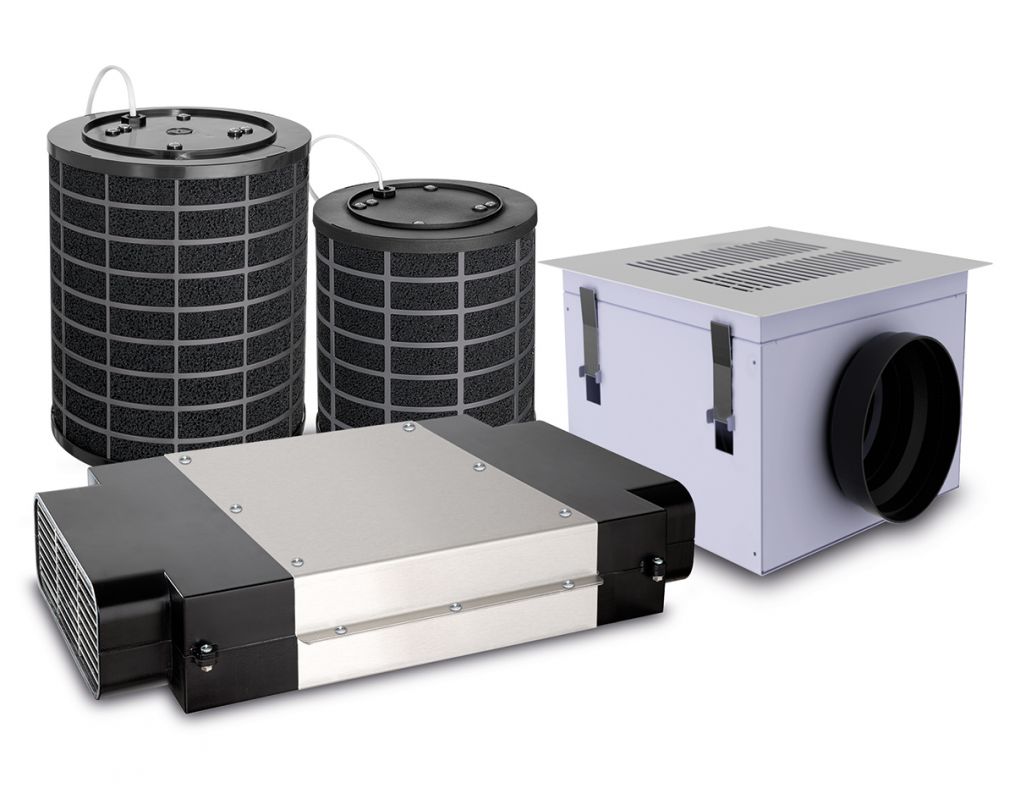
Want to take your kitchen air quality a step further?
Good extraction is about capturing cooking pollutants at source, but for kitchens using recirculating extraction, there is another option worth considering.
Plasma filtration.
Rather than simply trapping odours, plasma filtration uses a chemical process to treat the air before it is returned to the room. Miro’s plasma systems can purify up to 98% of particles, whilst also helping to reduce cooking odours and airborne impurities.
There’s another benefit too. Plasma filtration can help to reduce extraction noise by up to 14%, making it particularly appealing for open-plan kitchens where the extractor is operating alongside the living and entertaining space.
And unlike traditional carbon filters, which require regular replacement depending on usage, plasma filters are designed for long-term use, with a lifespan of up to 15 years and no routine maintenance required by the end user.
So, if you’re choosing a recirculating extraction system, plasma filtration could be worth considering as an additional layer of air treatment.
Because good extraction captures it. Plasma filtration takes things one step further.