
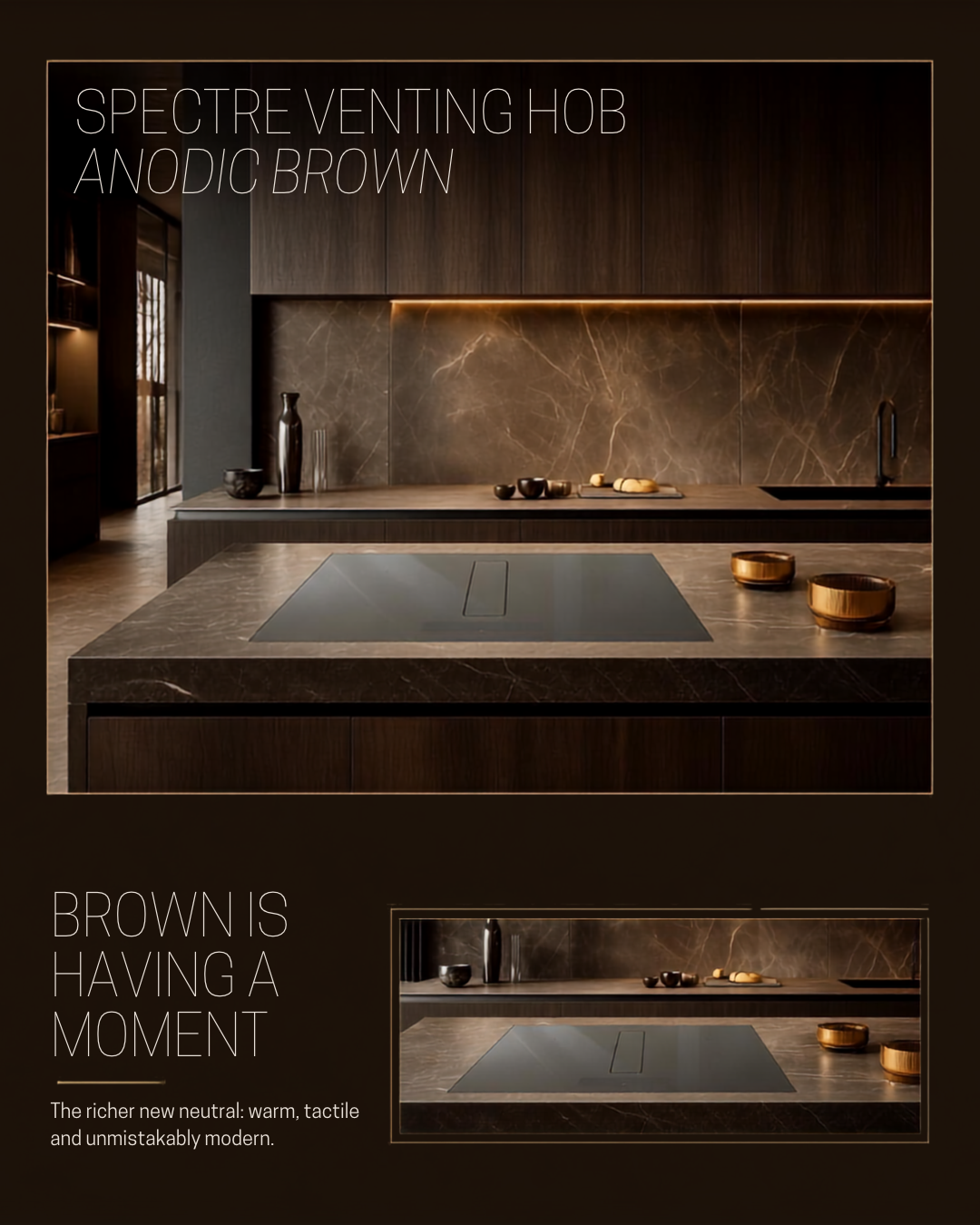
Brown is having a moment…
For years, the word neutral meant white, grey, beige and perhaps the occasional shade of cashmere.
But kitchen design is getting warmer.
We’re seeing more natural timber, deeper colours, tactile surfaces and richer tones finding their way into the heart of the home. And one colour in particular is quietly making a rather big comeback.
Brown.
Not the orange-toned oak of the 1990s. Not the dark, heavy kitchens of years gone by.
We’re talking walnut, tobacco, chocolate, coffee, chestnut and warm earthy browns – shades with depth, warmth and a little more personality.
And suddenly, brown doesn’t feel dated.
It feels very now.
The new neutral.
There is something interesting happening with kitchen colour.
After years of cool greys and ultra-light neutrals dominating contemporary design, homeowners and designers are looking for spaces that feel warmer, calmer and more connected to the rest of the home.
Brown happens to tick quite a few of those boxes.
It works beautifully with natural materials. It brings warmth to stone. It sits comfortably alongside brass and bronze. It makes black feel sophisticated rather than stark, and it gives lighter colours something to work against.
Perhaps most importantly, it doesn’t need to shout.
Brown is becoming neutral with character.
That is a big part of its appeal.
Current kitchen design is also moving away from the idea that everything has to match perfectly. Instead, designers are layering timber, stone, metal, colour and texture to create kitchens that feel more individual and less like they have just been lifted from a showroom.
And brown is rather good at bringing all of those elements together.
Wood, stone and a little bit of contrast.
The easiest way to make a brown kitchen work isn’t necessarily to cover everything in brown.
It’s about layering it.
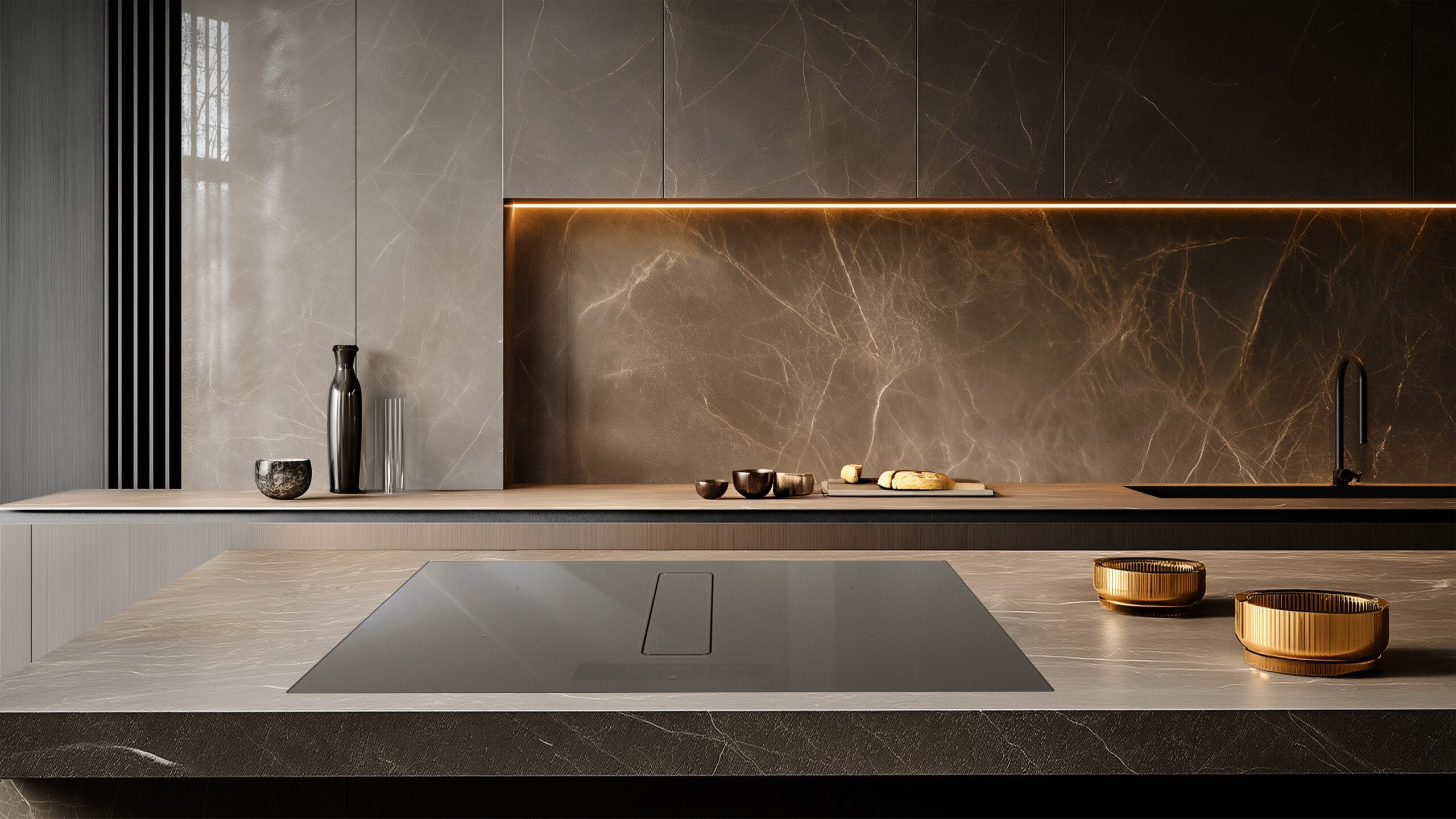
Deep walnut cabinetry against a lighter stone. A dramatic marble-effect splashback against timber. Brushed metal alongside darker finishes. Warm lighting picking out the grain of the cabinetry in the evening.
It’s the contrast between materials that stops the scheme becoming flat.
And that’s where the more contemporary brown kitchen differs from its predecessors.
Today’s version is less about one colour and more about depth and texture.
You might have dark timber cabinetry, a veined stone worktop, aged brass details and a soft, warm wall colour – all sitting within the same palette without everything being identical.
The result is a kitchen that feels considered rather than coordinated.
And then, of course, there’s the extraction.
Here’s where things get particularly interesting.
When you’re designing a kitchen this carefully, extraction shouldn’t feel like an afterthought.
A large stainless-steel hood can be the right choice in the right room, of course. But when the design is deliberately warm, tactile and understated, there is something to be said for an extractor that becomes part of the overall palette.
That’s one of the reasons the Spectre Opulence in Anodic Brown works so well within this kind of scheme.
The Spectre Opulence isn’t simply a black venting hob with a different colour option added for good measure.
Anodic Brown was made for kitchens like this.
At 800 x 520mm, the Spectre combines induction cooking with integrated extraction, meaning there is no need for a traditional overhead hood competing with the cabinetry, lighting or architectural lines of the room. It can also be installed flush with the worktop for an even more seamless finish.
And that matters when the worktop itself is part of the design.
Brown doesn’t have to mean dark.
And perhaps that’s the biggest misconception about brown kitchens.
You don’t need to create a moody, almost-black room to make the trend work.
Brown can be surprisingly light and versatile.
Think mushroom and walnut. Taupe and oak. Chocolate and cream. Tobacco and natural stone. Terracotta and soft beige.
Even a predominantly light kitchen can introduce brown through a timber island, a bank of cabinetry, furniture, flooring or simply through smaller details.
The trick is to use brown as a grounding colour, rather than treating it as a theme. That gives you a kitchen with warmth and personality without making it feel like you’re chasing the latest trend.
So, is brown here to stay?
Possibly. Maybe even ‘probably‘.
Not because brown is suddenly the colour to have, but because it fits into a much bigger shift happening in kitchen design.
We’re moving towards rooms that feel warmer, more personal and more lived-in.
Less clinical. Less perfectly coordinated.
More tactile. More individual.
And brown happens to be very good at all of that.
Perhaps the new definition of a neutral isn’t the colour that disappears into the background.
Perhaps it’s the colour that makes everything around it look better.
And if that is the case, brown might have just earned its place at the kitchen table.