
- What actually happens to cooking grease?
When you cook, particularly when frying, grilling or searing, you’re not just producing “smells”.
You’re producing a mixture of:
- grease
- oil aerosols
- fine particles
- steam
- moisture
- odour compounds
Some of those particles rise with the warm air. Some eventually land on:
- cupboards
- ceilings
- walls
- light fittings
- furniture
- fabrics
And in an open-plan kitchen? They’re not necessarily staying in the kitchen – they’re travelling into the living space.
The grease filter in an extractor is therefore doing a very important job before air even reaches the motor or secondary filtration.
- Do cooker hoods remove steam?
They can capture moisture-laden air – but don’t think of an extractor as just a magic steam vacuum.
If you’re extracting outside, moisture can be carried out of the building with the extracted air. If you’re recirculating, the air eventually comes back into the room, so the moisture hasn’t magically disappeared.
This is another reason extraction vs recirculation matters – and it’s particularly important in modern open-plan kitchens where cooking, dining and living areas share the same air.
- Plasma filtration explained
Here’s the simple version; a traditional recirculating extractor generally uses filters to capture grease and odours before returning air to the room.
Plasma filtration adds another stage of air treatment.
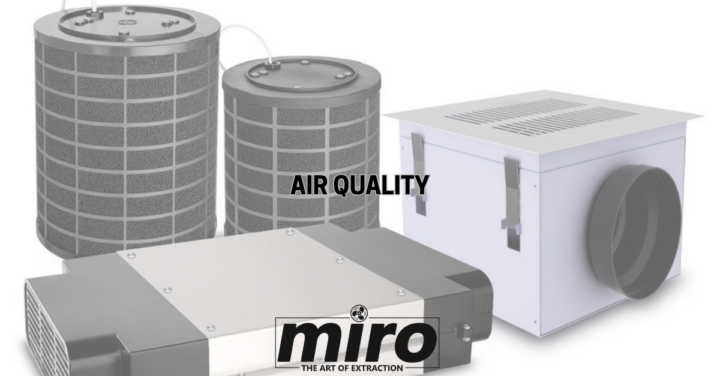
Miro’s plasma systems use an electrical discharge and subsequent chemical reactions to treat polluted air before it is returned to the kitchen and our systems can purify up to 98% of particles and can provide up to 15 years of lifespan, depending on system/use.
Another interesting benefit? Our plasma filters can reduce noise by up to 14% in specified configurations.
Simple explanations on extraction and filtration:
Extraction:
“Take the unwanted air outside.”
Carbon recirculation:
“Filter the air and put it back.”
Plasma recirculation:
“Treat the air more extensively before returning it.”
- Carbon filters vs plasma
Carbon
Pros:
- established technology
- relatively inexpensive
- effective at reducing cooking odours
- widely available
Cons:
- requires replacement
- performance depends on usage
- ongoing consumable cost
Our standard carbon filters can require replacement approximately every 3–6 months depending on your cooking/usage.
Plasma
Pros:
- much longer service life
- minimal end-user maintenance
- advanced air treatment
- useful where external ducting isn’t possible
- can also help with noise in certain configurations
Cons:
- higher initial investment
So the question isn’t:
“Is plasma better?” It’s “is the additional investment worthwhile for the way you use your kitchen?”
- How often should grease filters be cleaned?
The honest answer is, more often than most people probably do!
Your grease filters are effectively the first line of defence. If they’re clogged with grease, airflow can suffer and the extractor has to work harder.
Cleaning frequency depends on:
- how often you cook
- how much frying you do
- the type of cooking
- the filter design
- the manufacturer’s instructions
A household that cooks every night and regularly fries will need to clean filters much more frequently than someone who barely uses the hob.
If your filter looks like it belongs in a chip shop, it’s probably past the time to clean it.
Further information can be found here: MIRO SUPPORT | The importance of maintenance! – Miro Products | Premium Extractor Hoods
Always follow the specific cleaning instructions supplied with the appliance.